 Musa
Spain have been left with serious questions following their dramatic 3-2 defeat to England after the controversial decision to award Harry Kane a first-half penalty became one of the biggest talking points of their Nations League encounter.
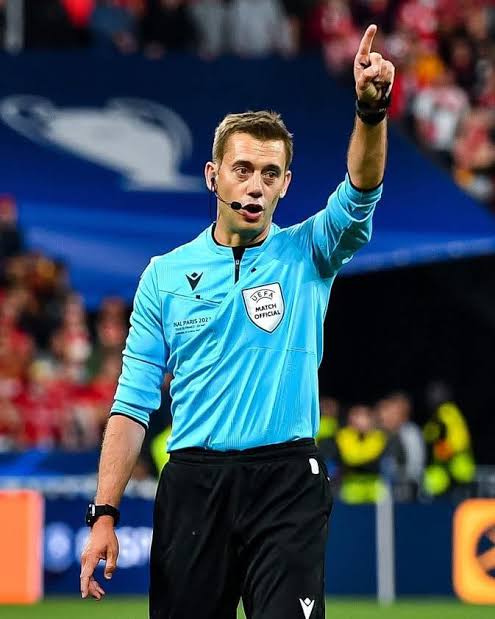
Luis de la Fuente’s side were particularly unhappy with the circumstances surrounding England’s opening goal, with the Spanish camp believing that an earlier incident involving Marc Cucurella and Elliot Anderson deserved greater attention from referee Clément Turpin.
However, despite the lengthy VAR examination, the decision to award England the penalty was upheld, allowing Kane to put Thomas Tuchel’s side ahead just before half-time.
The incident has generated considerable debate because it involved two separate challenges within the same attacking move, raising questions about how VAR officials assess potential attacking infringements before a penalty is awarded.
According to the International Football Association Board’s (IFAB) VAR guidelines, video officials can intervene when there is a clear and obvious error or a serious missed incident involving a penalty decision.
The rules also allow VAR to examine possible attacking infringements during the attacking possession phase leading to a penalty.
This means that officials must consider whether an attacking player committed an offence before the incident that resulted in the spot-kick.
How Elliot Anderson and Marc Cucurella became involved in the controversy
The controversy began during an England attacking move when Jude Bellingham appeared to be fouled by Cucurella.
Anderson subsequently collected possession and delivered a forward pass towards Kane, who managed to get himself into a dangerous position inside the Spanish penalty area.
However, the England midfielder’s follow-through caught Cucurella, who went down and remained on the pitch, seemingly appealing for an infringement.
The attention then shifted towards Kane, who had managed to position himself between the ball and Pau Cubarsí.
The Barcelona defender attempted to challenge the England captain but made contact inside the penalty area, prompting Turpin to immediately award a penalty.
Spain’s players were furious with the decision, particularly because they believed Anderson’s earlier contact with Cucurella should have been considered before the referee confirmed the spot-kick.
VAR subsequently examined the sequence, including the possibility of an attacking infringement by Anderson.
Nevertheless, the officials did not identify grounds to overturn Turpin’s original decision.
Kane eventually stepped forward and converted the penalty, giving England a crucial 1-0 advantage at the interval.
Why the VAR rules allowed England’s penalty to stand
The important detail surrounding the controversy is that an attacking player making contact with an opponent does not automatically constitute an offence.
Under the Laws of the Game, a foul must satisfy the relevant conditions, including whether a challenge was careless, reckless or involved excessive force.
The VAR process also requires officials to distinguish between an actual infringement and contact that does not meet the threshold for a foul.
In this particular incident, the available match reporting described Anderson’s contact with Cucurella as accidental, although it was also characterised as nasty.
The officials therefore allowed the original decision to stand.
IFAB’s guidance makes clear that VAR is not intended to overturn every debatable refereeing decision. Its intervention is restricted to clear and obvious errors and serious missed incidents within the relevant review categories.
Importantly, the final decision remains with the referee, even when VAR assistance is provided.
This explains why the penalty was not automatically cancelled simply because Spain’s players appealed for an earlier foul.
De la Fuente faces questions after England punish Spain
For De la Fuente, the controversy represented another frustrating moment in an encounter that eventually slipped away from his team.
Spain entered the match hoping to finish their Nations League group campaign on a positive note, but England produced an outstanding performance during the opening stages.
The visitors subsequently increased their advantage through Ezri Konsa in the 53rd minute before Ben White made it 3-0 just four minutes later.
Spain eventually found a way back into the contest after Elliot Anderson was sent off for bringing down Lamine Yamal inside the penalty area.
Mikel Oyarzabal converted the resulting spot-kick before Nico Williams scored again in the 75th minute.
Despite their late comeback attempt, Spain could not find an equaliser, with England holding on to secure a memorable victory in Madrid.
The result ended Spain’s 43-match unbeaten run and confirmed England as Group A3 winners.
The penalty controversy is unlikely to disappear immediately
Although England deserved credit for their performance, the circumstances surrounding Kane’s opening goal have provided Spain with another reason to question the officiating.
The most significant issue is whether Anderson’s contact with Cucurella should have been considered an attacking infringement before the penalty was confirmed.
However, without an official statement from FIFA or UEFA specifically addressing the incident, it would be premature to claim that football’s governing bodies have issued a definitive explanation of the decision.
What is clear is that the VAR officials reviewed the sequence and found insufficient grounds to overturn Turpin’s original penalty award.
For Spain, the disappointment will be even greater because the decision contributed to an evening that ultimately ended with England celebrating a historic victory in Madrid.


 Musa