 Musa
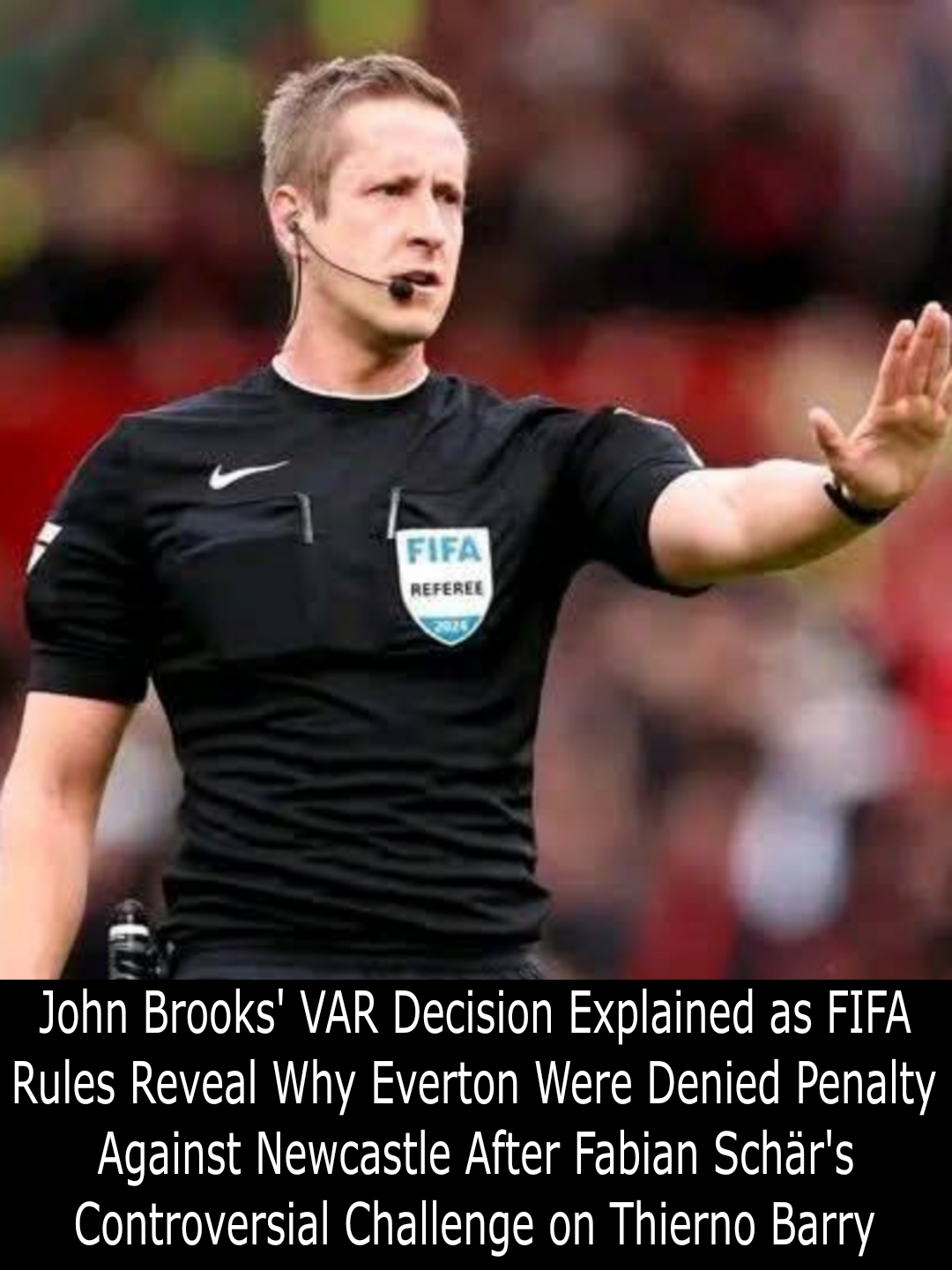
Everton were left frustrated after referee John Brooks refused to award them a penalty during their Premier League encounter against Newcastle United, following a controversial challenge by Fabian Schär on Thierno Barry at St James’ Park.
The incident, which occurred around the 70th minute, quickly became one of the biggest talking points of the contest, with Everton manager David Moyes visibly unhappy with the decision and even receiving a booking for entering the field to protest.
Despite the protests from the Everton technical area, Brooks and the Video Assistant Referee (VAR) team decided against awarding a spot-kick, allowing Newcastle to escape what could have been a significant moment in the closing stages of the match.
Everton eventually secured a 1-0 victory through Thierno Barry’s second-half goal, but the penalty controversy has provided another talking point for supporters questioning the consistency of Premier League officiating.
What exactly happened between Fabian Schär and Thierno Barry?
The incident developed when Everton worked the ball towards the Newcastle penalty area through a combination involving Kiernan Dewsbury-Hall and Merlin Röhl.
Röhl delivered a low cross into the penalty area, looking to find Barry, who was attempting to get on the end of the delivery.
However, Schär reacted quickly and launched himself into a sliding challenge, appearing to reach the ball before making substantial contact with the Everton striker.
Barry subsequently went to ground following the collision, prompting immediate appeals from Everton players for a penalty.
Brooks, however, was not convinced that a foul had occurred and allowed play to continue.
The decision was subsequently checked by VAR, but the original on-field ruling was allowed to stand.
The Guardian’s live match reporter questioned the decision, suggesting that Schär appeared to make contact with Barry before properly winning the ball. Moyes was also visibly frustrated, protesting the outcome from the touchline.
Why John Brooks did not award the penalty under FIFA rules
Although Everton supporters may feel that Barry was unfairly brought down, the Laws of the Game provide an important explanation of why a penalty cannot automatically be awarded whenever a defender makes contact with an attacker inside the penalty area.
Under IFAB Law 12, which governs fouls and misconduct, a direct free kick is awarded when a player tackles or challenges an opponent in a manner considered careless, reckless or involving excessive force.
The distinction is particularly important when assessing sliding tackles.
A challenge is considered careless when a player shows a lack of attention or consideration, or acts without precaution.
A reckless challenge involves disregard for the danger or consequences for an opponent and warrants a yellow card, while excessive force that endangers an opponent’s safety requires a red card.
However, if the referee determines that a defender has made a fair challenge and has not committed an offence under those definitions, allowing play to continue is the correct decision.
This is where the interpretation of Schär’s challenge becomes crucial.
If Brooks and VAR concluded that the Newcastle defender reached the ball first and that his subsequent contact with Barry was an unavoidable consequence of a legitimate challenge, there would be no automatic reason to award Everton a penalty.
Nevertheless, winning the ball first does not automatically excuse every subsequent action. A defender can still commit a foul after making contact with the ball if the follow-through is careless, reckless or uses excessive force.
Therefore, the key question is not simply whether Schär touched the ball first, but whether the overall challenge was fair under Law 12.
Why VAR refused to overturn John Brooks’ decision
Another important consideration is the threshold required for VAR intervention.
VAR is not designed to re-referee every physical challenge or overturn every decision that generates disagreement.
Under the VAR protocol, a review for a potential penalty is concerned with whether the referee made a clear and obvious error or missed a serious incident.
In this particular situation, Brooks had already decided that Schär’s challenge did not constitute a foul.
For VAR to recommend an intervention, the available footage would need to demonstrate that the original decision was clearly wrong.
If the video officials believed the defender had made a legitimate attempt to win the ball and that the contact did not amount to a punishable offence, they could reasonably support the referee’s original decision.
However, that does not mean the decision is beyond debate.
The Guardian’s description of the incident suggested that the sequence deserved closer examination, particularly because Schär’s leg appeared to travel through Barry’s legs after the initial challenge.
Without the official VAR communication or a published explanation from the Premier League Match Centre, it would be inaccurate to claim that Brooks personally confirmed this interpretation.
Could Everton have been awarded a penalty?
Yes. If a closer examination of the footage established that Schär’s sliding challenge was careless or reckless, Everton would have had grounds for a penalty under Law 12.
The law does not require a defender to deliberately bring down an opponent before a foul can be awarded.
A careless challenge can be sufficient, even without malicious intent.
Furthermore, if the challenge was reckless, Schär could also have faced disciplinary action.
The location of the incident is equally important. Because the challenge occurred inside Newcastle’s penalty area, a punishable direct-free-kick offence would result in a penalty rather than an ordinary free kick.
Ultimately, the decision depended on Brooks’ assessment of the contact and whether VAR found sufficient evidence to overturn his original judgement.
Another refereeing debate for the Premier League
Everton may have taken all three points, but the incident involving Schär and Barry has added another controversial refereeing moment to an increasingly heated Premier League season.
For Newcastle, the decision provided an important escape from a potentially dangerous situation as they attempted to find an equaliser.
For Everton, however, the frustration was understandable, particularly given Barry’s involvement in the incident and Moyes’ reaction on the touchline.
The laws are clear: contact alone does not automatically mean a foul, and winning the ball does not automatically make a challenge legal.
That distinction ultimately sits at the heart of the controversy surrounding John Brooks’ decision.
Until the Premier League releases an official explanation or further footage clarifies the precise contact, the debate over whether Everton deserved a penalty is likely to continue.

 Musa